Break-even Calculator
Know your costs. Find your turning point.
Find out how many units you need to sell to cover your costs, estimate break-even revenue and explore how your selling price affects profitability.
💵 Enter your business numbers
💡 Use the same time period for your fixed costs and expected sales. For example, enter monthly fixed costs and expected monthly sales.
🎯 Set a profit target
Enter how much operating profit you’d like to earn above your fixed and variable costs. Use zero to calculate break-even sales only.
⚙️ What counts as a cost?
Fixed costs: Expenses that don’t change with each unit sold within the relevant operating range, such as rent, recurring software subscriptions and some salaries.
Variable costs: Expenses directly associated with each sale, such as product materials, packaging, transaction fees and sales commissions.
The calculator assumes a constant selling price and variable cost per unit. It does not model taxes, changing prices, capacity limits or step increases in fixed costs.
📊 Revenue vs. total costs
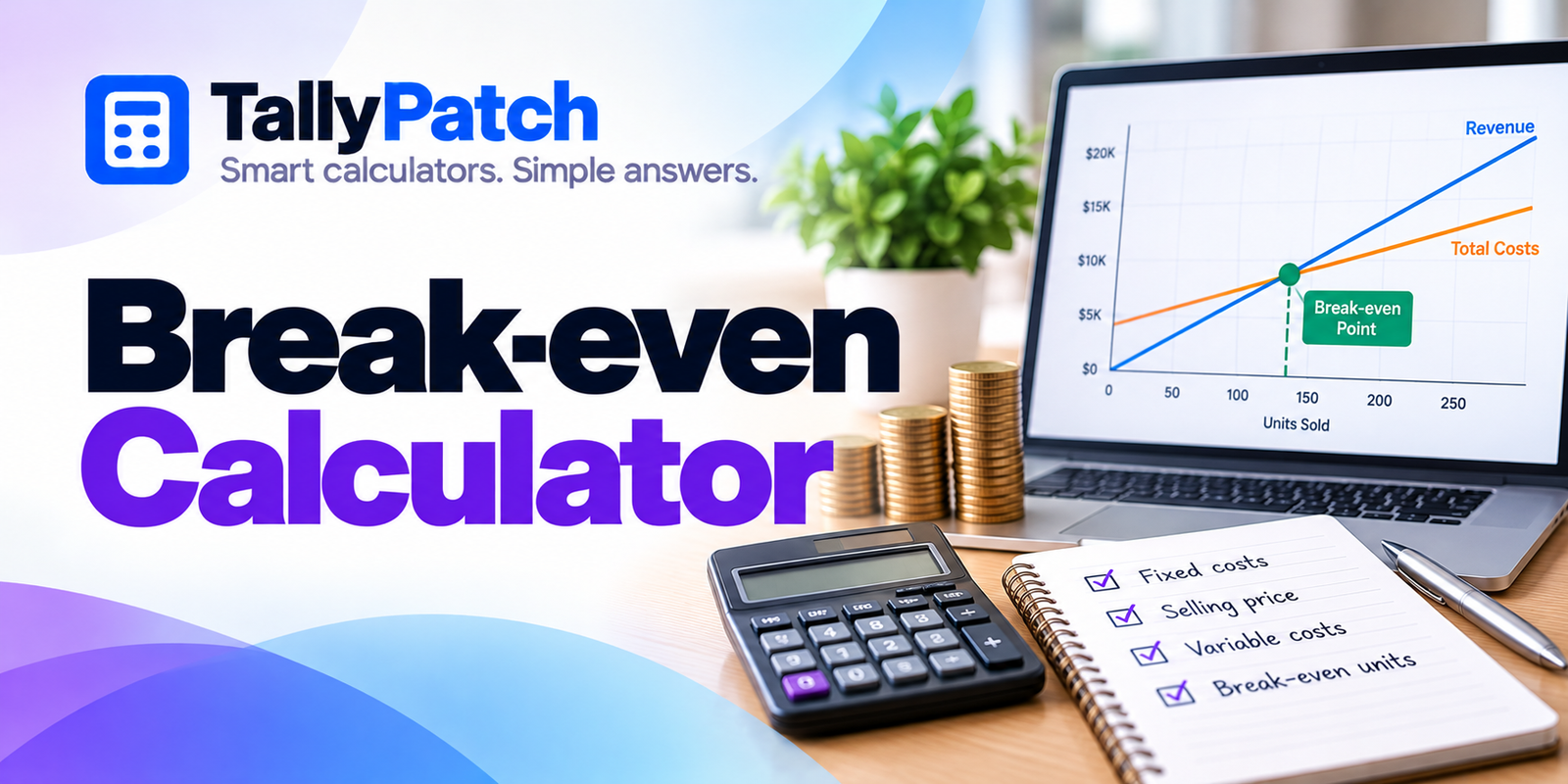
The blue line represents sales revenue. The orange line represents fixed plus variable costs. The intersection marks the theoretical break-even point before whole-unit rounding.
🧠 How to calculate your break-even point
Your break-even point is the sales volume where total revenue equals total costs. Below that point, the business loses money on the costs included in the calculation. Above it, additional contribution can generate operating profit.
The difference between selling price and variable cost is called the contribution margin per unit. It represents the amount each sale contributes toward covering fixed costs and generating profit.
🧮 Example: A small product business
Imagine your business has $5,000 in fixed costs. You sell a product for $50 and spend $20 in variable costs per unit.
Each sale contributes $30 toward fixed costs and profit. Dividing $5,000 by $30 gives approximately 166.67 units, so you need to sell 167 whole units to break even.
To reach a $2,000 profit target, you would need to sell 234 units.
💡 Frequently Asked Questions
Breaking even means your revenue is sufficient to cover the fixed and variable costs included in your calculation. At the exact break-even point, operating profit is zero.
First calculate the number of whole units required to break even, then multiply by your selling price. For continuous sales values, the theoretical break-even revenue can also be calculated using your contribution margin ratio.
Contribution margin per unit is the selling price minus variable cost per unit. It tells you how much each sale contributes toward fixed costs and profit.
Each additional sale would increase your loss before considering fixed costs. You generally cannot reach break-even through additional sales under those assumptions.
Add your desired profit to your fixed costs, then divide by the contribution per unit. Round up to a whole unit when products or services cannot be sold fractionally.
Yes. Treat each service appointment, project or billable unit as a sale. Enter the revenue and variable costs per service, along with your fixed operating expenses.