Concrete Calculator
Plan your pour. Know your quantities.
Estimate how much concrete you need for a rectangular slab, patio, walkway or similar project. Calculate cubic yards, cubic metres, bag quantities and material costs.
📏 Enter your project dimensions
💡 Measure the actual dimensions of your concrete pour. This calculator assumes rectangular slabs of uniform thickness.
⚙️ Concrete and waste allowance
Bag yields vary by product. The default assumes approximately 0.6 cubic feet of mixed concrete per 80 lb bag. Confirm the yield on the packaging.
💰 Optional material pricing
Prices are editable examples, not current supplier quotes. Ready-mix estimates use the calculated volume, without minimum-order rounding, delivery or short-load fees.
🧠 How to calculate concrete volume
To estimate concrete for a rectangular slab, multiply its length by its width and thickness. Make sure all dimensions use consistent units before calculating the volume.
For imperial measurements, divide thickness in inches by 12 to convert it to feet. Multiply length, width and thickness to find cubic feet, then divide by 27 to convert cubic feet to cubic yards.
Add an allowance for variations in excavation, uneven surfaces and material loss. Actual quantities may differ from the estimate.
🧮 Example: A 12 × 10 ft concrete patio
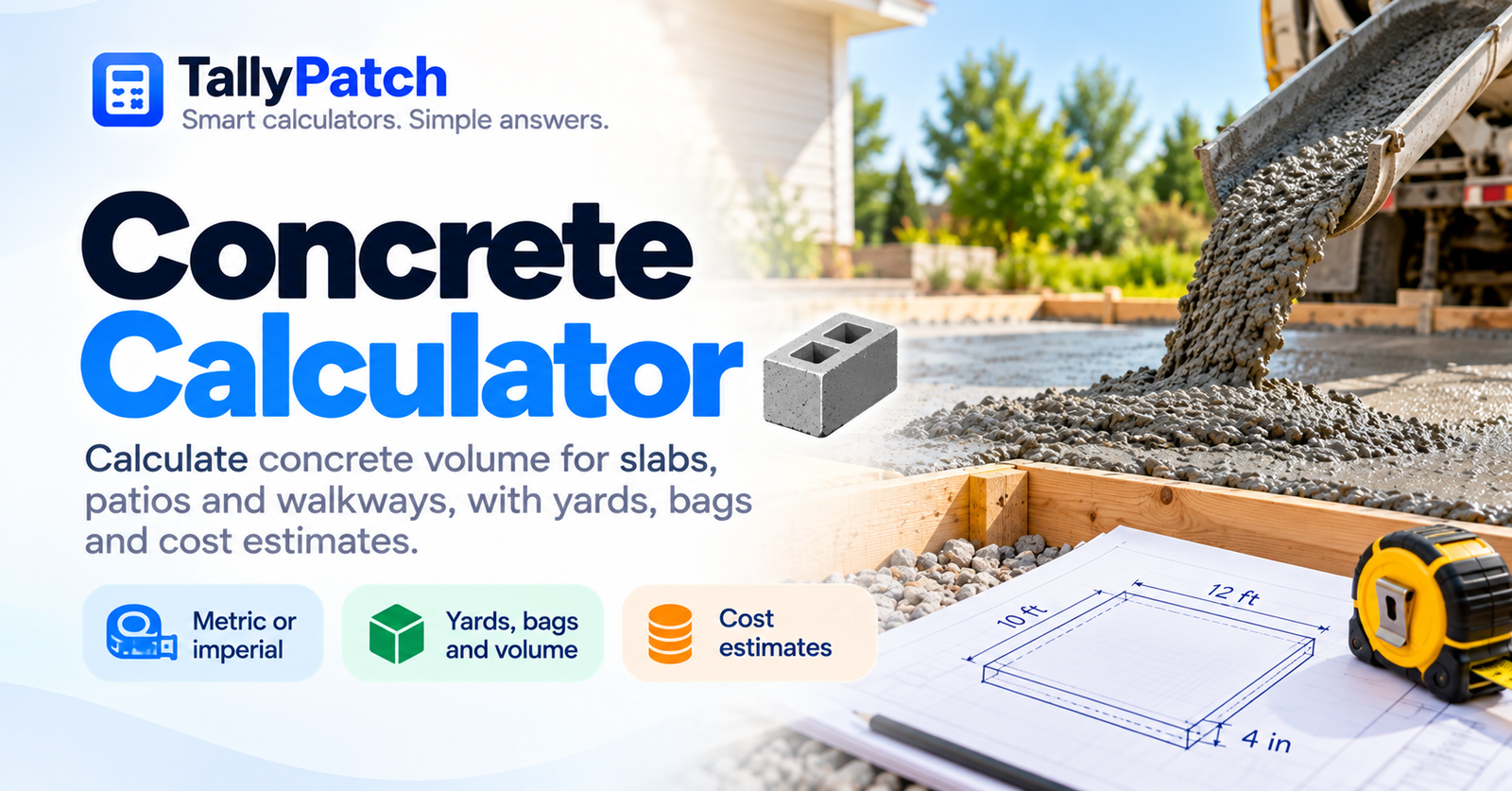
Suppose you’re pouring a rectangular patio measuring 12 feet long, 10 feet wide and 4 inches thick.
Its volume is 12 × 10 × (4 ÷ 12), or 40 cubic feet. That’s approximately 1.48 cubic yards before extra allowance.
Adding 10% gives approximately 44 cubic feet, or 1.63 cubic yards.
💡 Frequently Asked Questions
At an estimated yield of 0.6 cubic feet per bag, one cubic yard requires 45 bags. Actual yield depends on the product, so check the manufacturer’s instructions.
Thickness depends on intended use, soil conditions, loads and local construction requirements. A 4-inch slab is common for some light-duty applications, but it isn’t appropriate for every project.
Often, yes. An allowance can help account for uneven excavation, measurement differences and material loss. Confirm the appropriate allowance with your concrete supplier or contractor.
It depends on project size, local pricing, delivery fees and minimum orders. Bagged concrete may suit smaller projects, while ready-mix delivery can be more practical for larger pours.
Yes. Use the identical-slabs field when the dimensions are the same. For different sizes, calculate each slab separately and combine their volumes.