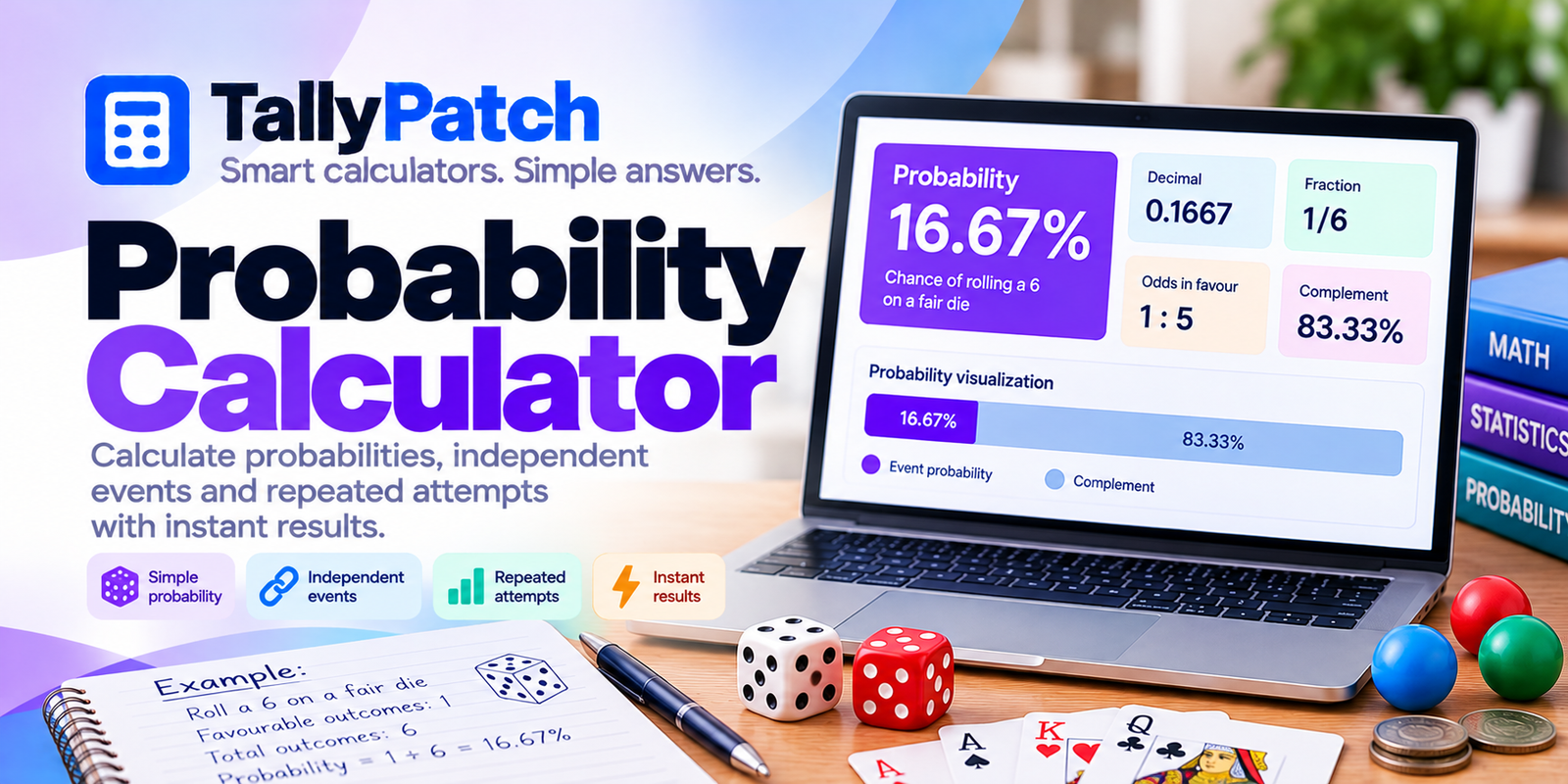
Probability Calculator
Understand the odds. Explore the possibilities.
Calculate the probability of an event, combine independent events or find the chance of at least one success across repeated attempts. Get instant answers in percentages, decimals and odds.
🎲 Choose your probability calculation
🎯 Basic probability
Use this mode when all possible outcomes are equally likely.
Example: Rolling a 6 on a fair six-sided die has 1 favourable outcome out of 6 possible outcomes.
⚙️ Understanding the assumptions
Basic probability assumes all outcomes are equally likely. Divide favourable outcomes by total possible outcomes.
Probabilities range from 0% (impossible) to 100% (certain). Independence is essential for the multiple-event and repeated-attempt formulas.
🧠 How to calculate probability
Probability measures how likely an event is to happen. When every outcome is equally likely, divide the number of favourable outcomes by the total number of possible outcomes.
Multiply the result by 100 to express probability as a percentage.
🧮 Example: Rolling a six-sided die
Suppose you roll a fair six-sided die and want to know the probability of rolling a 6.
There is one favourable outcome out of six equally likely outcomes. The probability is 1 ÷ 6 = 0.166667, or approximately 16.67%.
🔗 Probability of independent events
Two events are independent when the outcome of one does not affect the probability of the other. To find the chance of both happening, multiply their probabilities.
For example, a 50% chance of event A and a 25% chance of event B produce a 12.5% chance that both occur, assuming independence.
🔁 Probability of at least one success
For repeated independent attempts with the same success probability, it is often easier to calculate the chance that every attempt fails, then subtract that from one.
Here, p is the success probability of one attempt and n is the number of independent attempts.
💡 Frequently Asked Questions
It means the event has a 25% chance of occurring, equivalent to one chance in four under the stated assumptions.
If the events are independent, multiply their individual probabilities. If they are dependent, you need conditional probability instead.
The complement is the event not occurring. Its probability is 1 minus the probability of the original event.
No. Valid probabilities range from 0 to 1, or from 0% to 100% when expressed as percentages.
For independent attempts with the same positive probability of success, more attempts increase the chance of at least one success. This does not mean an individual attempt becomes more likely to succeed.
Yes, for simple equally likely outcomes. For draws without replacement or dependent events, a more specialized calculator may be needed.